What did the ISDT riders do during the war?

Tags

, , , , , , ,


Image scanned photo from article 'the Recorder' 21 June 1941 BRITISH DESPATCH RIDERS.—"Swift and Sure" is the motto of the Royal Corps of Signals'of Britain's Army. Many of its motor cycle despatch riders are famous on motor racetracks. - (Department of Information photo).

Image scanned photo from article ‘the Recorder’ 21 June 1941 BRITISH DESPATCH RIDERS.—”Swift and Sure” is the motto of the Royal Corps of Signals’ of Britain’s Army. Many of its motor cycle despatch riders are famous on motor racetracks. – (Department of Information photo).

Many of the works riders when drafted into the forces in 1939 who were not already army riders found their skills were sought after to ensure the army had a full compliment of riders who could take motorcycles into action.

Continue reading

Not just about the motorbike: where did the Beetle come from?

Tags

, , ,


A rare outbreak of moment of personal indulgence.. this is nearly my 100th blog after all

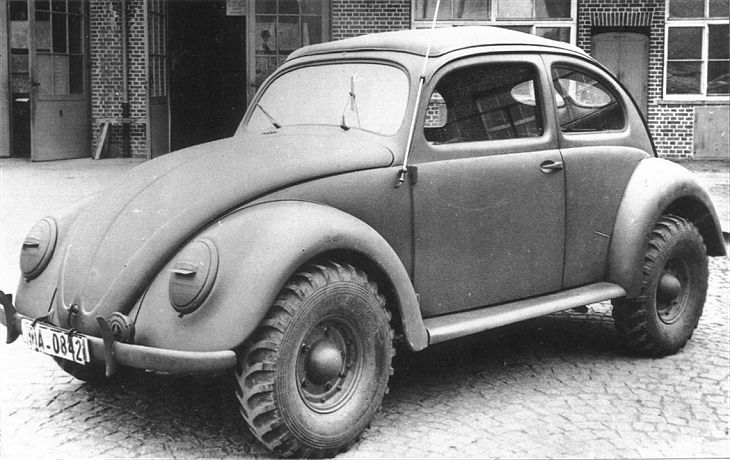
Photo - KDF Wagen

Photo – KDF Wagen

Whilst busy trawling through the vast ocean rich with articles abut the International Six Days’ Trial in the archive of the National Library of Australia’s interwar years newspapers, sat alongside a key report on the ISDT 1938 I stumbled onto an article on the development in Germany under the direction of a well known despot the production of a new car for the citizens of Germany one that would cost only the equivalent of the average workers salary for 20 weeks. In addition this car would be built in a factory run by the state in direct competition to the private sector who had failed to take up the design challenge… Unlike however the ill-fated efforts at state car building in Britain or the Meridan co-operative at the end of our bike indutry. From this humble beginning came one of the worlds greatest cars and one of the worlds largest and advanced automotive companies.

As a help to any other VW Beetle fans or researchers who stumble onto this blog I have added below some of the treasure of articles about the arrival of the KDF Wagen and its liberation at the end of the war.

PEOPLE’S CAR

Huge German Factory BRIEF DETAILS

If things turn out according to Herr Hitler’s programme to build for the German people, in the next few years, millions of low priced motor cars at the huge Government factory now being erected in Brunswick, the people of that country will be able to buy a new car through the Labour Front at the equivalent of 5/ a week, plus about 1 / a week for insurance

Continue reading

ISDT Research: Historic Newspapers

Tags

, , , , ,


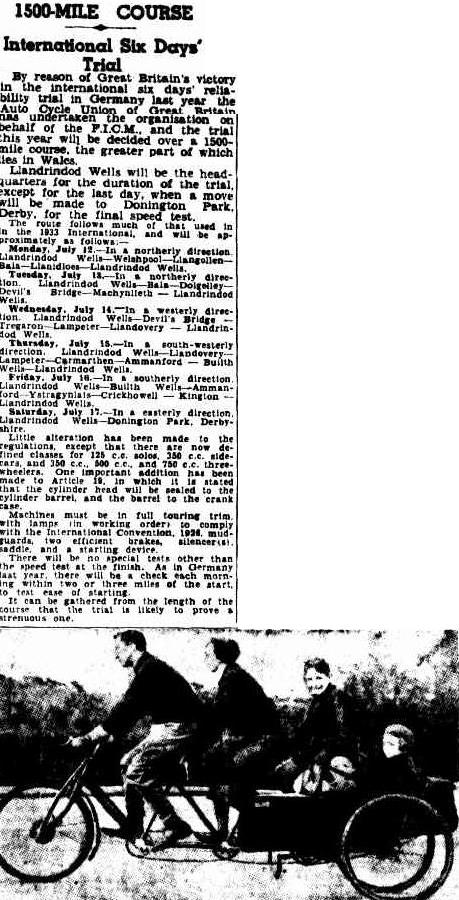
Whilst recovering the history of the ISDT, sometimes from oblivion, much of what happened prior to the war is no longer accessible via living memory. Most of the pre-war racers and the event supporters have sadly left our company over the last 10-30 years. Whilst we may still have those copies of the old magazines ‘the Motor Cycle‘ and ‘Motor Cycling‘ neither are published any longer and so its a case of trawling old archives and eBay auctions to find any references to the ISDT which is often fraught with difficulty and significant cost. These magazines tell us the story from the enthusiasts point of view but it’s also clear the International was a major sporting man familiar with many people with little active interest in the events and it is intersting to see how it was perceived then by the man in the street to compare to the sports relative anonymity today. A surprisingly great source for this kind of material is the daily national and regional newspapers of the time.

image - scanned from the Courier - Mail, from Brisbane Queensland Australia 10th May 1937 ISDT 1937

image – scanned from the Courier – Mail, from Brisbane Queensland Australia 10th May 1937 ISDT 1937

the image of the cycling contraption is described in its caption as this: FAMILY CVCLE.— An unusual machine, devised by a resident of Kent, England, to solve the transport problem for five people.

Continue reading

Remembrance Sunday 2013: Motorcyclists at war

Tags

, , , ,


As another year passes as we approach Remembrance Sunday this weekend and Armistice Day on the 11th November. The remembrance of the war has always been considered of great importance by British Motorcycle clubs, many clubmen riders went war and many never returned, those who remain have always believed that this sacrifice should not go un-noticed. I do not want this article to simply be a mark of respect to the many British soldiers who were called up by their nation to defend this country and paid the ultimate price for our freedom with their life. The ISDT has been an international community and at the same time as many British Racers were called up and ran the risk of not returning home, riders of other nations were being required to do just the same facing the same penalty. The time to remember the wrong of particular wars is no longer important it is well studied and taught as part of school curriculum history. However the anonymous individuals who were the casualties and who perished, deserve remembrance as the years pass and the witnesses no longer remain to remind us of the  cost that war imposes on all those who take part in it.

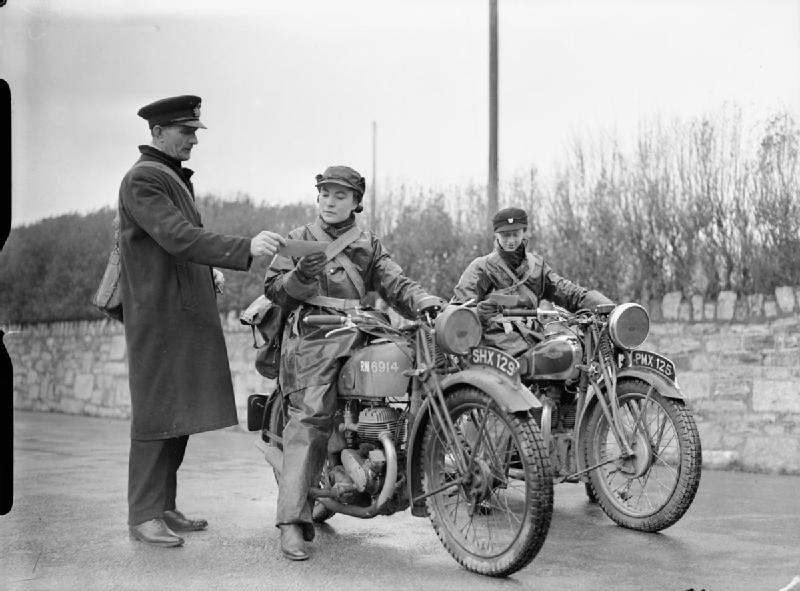
Photo - Women Dispatch riders on Royal Enfield Motorcycles (Image courtesy Imperial War Museum)

Photo – Women Dispatch riders on Royal Enfield Motorcycles (Image courtesy Imperial War Museum)

I have included a number of images from the archives of the Imperial War Museum. But would encourage you to take the time to listen to this recording of Wrexham Steelworker Trevor Edwards, born 1917, from Ffrwd near Wrexham. Continue reading

Where did it go? mapping the ISDT

Tags

, , , , , , , , , , , ,


I can recall whilst out trail riding in the Clwydian Hills in my teens during the late 70’s when one of the old blokes pointed into a hedge (they said it was a track, but you could not get into it to stand and look.. it was a hedge) and that once the ISDT had gone up there…. I knew the event and it filled my head with images of far off exotic trails in wild forests. I had never even heard of  the ISDT in Wales although I knew that once the Tour of Wales Enduro had come these ways it had not done so for years, the only active local off road competition were the Scrambles at Bodfari, the Fosters Cup an observed trial run by the South Liverpool Club and local observed trials organised by the Denbigh and Mold MCC. Even so that story stuck in my head and everytime i drive past this hedge I think the ISDT went there once.

Image – Scanned copy of course map as published in either Motor Cycle or Motor Cycling for the ISDT 1938

Continue reading

ISDT: Women and Motorcycling revisited

Tags

, , , ,


After picking up the task of restoring Taff’s old website Speedtracktales back in May 2012 from a cd of memories to its former glory, many areas of the story it told opened my eyes and dispelled a belief that our daily life was evidence that we had advanced as a society, it became clear we have in some ways stagnated or gone back in time by comparison to opportunities taken for granted in the past.

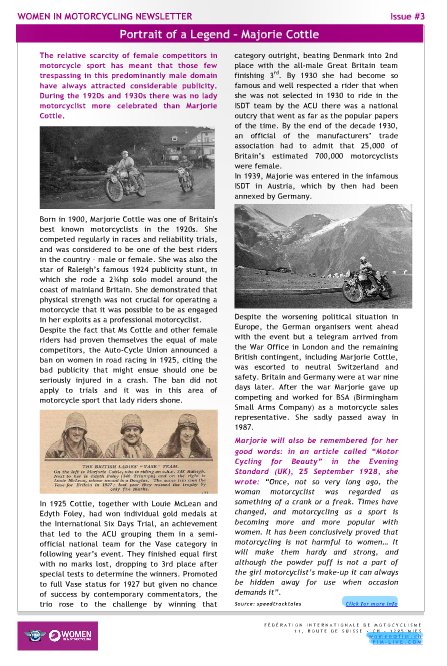
I was particularly inspired in reading and rediscovering the feats of the ACU ‘Ladies’, a fearless but quite civilised corp of women who took their place in Motorcycle racing as equals, although a minority. The history of Motorcycle sport that I have participated in has depended heavily on the willingness of wives, girlfriends and mothers to put in a great effort but sometimes felt that role was not properly recognised nor the many women racers adequately covered. This gave rise to an article I wrote about the many Women at the ISDT who were led by presence of the very strong character of Marjorie Cottle who featured in her own article, a great niece of whose recently visited this site giving much pleasure. Although towards the end of the ISDT women had all but disappeared, there has been a renaissance of recent years in world enduro and so much so there is a women’s team prize in the ISDE. My hope is the sport will get more competitive and more popular possibly as young women introduced into the sport through action & gravity sports, such as MTB downhill, find that they can transfer those skills to a motorcycle as Wales based international Downhill racer Fionn Griffiths has being doing in both British and European Enduro events riding for KTM.

Image - Article in Marjorie Cottle in FIM Women in Motorcycling Magazine

Image – Article in Marjorie Cottle in FIM Women in Motorcycling Magazine

It came as a great pleasure when browsing recent FIM publications to see their ‘Women in Motorcycling Newsletter‘ which in issue 3 of 2013 featured a fantastic article on Marjorie, who remains a modern inspiration and, just like the often overlooked 20’s English travel writer Freyer Stark, her life is long overdue a Hollywood / Elstree Biopic feature film. I am please also to note that the FIM credits Speedtracktales as the source of their article. Its great to be paying back our gratitude to the FIM for the help they have given scanning their archive of ISDT results for our use.


ISDT 1939: Day 4 report as published in ‘Das Motorrad’ Magazine

Tags


This post is a serialisation of an article that originally appeared over 75 years ago in ‘Das Motorrad’, the popular Motorcycling magazine in the German Language as it covered the proceedings of the 1939 ISDT, an event to finish in controversy and the results eventually annulled by the FIM.

After Day 1Day 2 & Day 3 we get to day 4

ISDT 1939 – Report from ‘Das Motorrad‘: The 4th Day

report by Von Gustav Mueller

The forth day mainly went through the Tyrol region, so it had been named the Tiroler Strecke[1]. During this day, there were some bad off-road difficulties, especially where one would not expect them.  The pass of Grießen and the pass of Thurn were easy, but the Gerlos pass is quite an affair. And then, there were these well known old acquaintances from earlier six days and winter rides, the “Bauer in der Au” and the “Valepp”[2] where they once had to carry emergency supplies by ski to the riders caught on a winter ride, who had been trapped there by snow, and the Sudelfeld[3]. At the “Bauer in der Au” Wiggerl Kraus had been among the spectators, he was quite well again.

The officials had chosen to use this day to sort out the gold medalists. It is quite understandable, that the officials do not like too many gold medalists, but the method they used, simply shortening the time standards, is the wrong way. The very good riders normally will deal with this situation, but with highest dedication, i.e. riding with high risk. If there is opposing traffic in a bend they cut, a crash will happen. Of course, this doesn’t happen so often to the “extra class” riders, as it does happen to the “first class” riders, or even more to the “only good” riders. Reason is, that these “extra class” riders have extremely short reaction times, so that they can get out of these dangerous situations.

But it can’t be the purpose of this event to get the riders into life threatening situations. A different way, means a less dangerous way, must be found to screen out the gold medalists. Without any doubt, the organisers do know this, but they still haven’t found the right way to do it. Also, it is the riders own fault, that the time schedules get always shorter, as they often ride at such high speed, that they have to wait up to half an hour in front of the time checks.

Of course, you need some time in advance, as a reserve for some incidents, but that must be done prudential and within certain limits. As soon as one has some advance, the speed for the rest of the distance should be slowed down. The ambition of some riders to overtake everyone in front of them, is only silly. This senseless chase is the reason for many tyre punctures, and other defects, too.

The best proof that calm riding can be the right way is seen in Pierre van Maldeghem, president of the Belgian motorcycle association, who always rides smooth, and who did stay without marks until the 3rd day, but then he took  3 marks on the 4th day and another 4 on the next day, due to the shortened times. There are some sensible riders who say, that the rider who goes for a silver medal from the beginning, has the best chance to earn a gold medal in the end.

Photo – #110 The NSKK-Obertruppführer [comparable to staff sergeant] Röser, who right at his first appearance at Schönerlinde made people talk of him, did become an excellent off road rider. Here he can be seen with his BMW at a steep climb, on his way to the next to last checkpoint. ISDT 1939 (das Motorrad)
Photo – #110 The NSKK-Obertruppführer [comparable to staff sergeant] Röser, who right at his first appearance at Schönerlinde made people talk of him, did become an excellent off road rider. Here he can be seen with his BMW at a steep climb, on his way to the next to last checkpoint. ISDT 1939 (das Motorrad)
Continue reading

ISDT 1939: Day three report as published in ‘Das Motorrad’ magazine

Tags


This post is a serialisation of an article that originally appeared over 75 years ago in ‘Das Motorrad’, the popular Motorcycling magazine in the German Language as it covered the proceedings of the 1939 ISDT, an event to finish in controversy and the results eventually annulled by the FIM.

After Day 1 and Day 2 we arrive at Day 3

ISDT 1939 – Report from ‘Das Motorrad‘: The 3rd Day

report by Von Gustav Mueller

Of course, all the officials and team members did meet at the time check up at the Großglockner[1]. The road is too inviting, especially if you can’t get there for free! But even if one has to abstain from something else for this, if one is in this region, you have to ride up onto the Glockner, that is a point of honour. And, possibly directly afterwards to the Franz-Joseph-Haus. But the best is the descent to Heiligenblut. For this, you need to have some luck, as the weather changes quickly up there, and with some bad luck, you may sit in the fog. This part of the event gave a lot to the competitors, as the Glockner road is splendidly constructed, so that it could be done easily within the time schedule. At the top, right in front of the check point, they had some time to have an ample look around.

Photo – Sometimes it became very tough, and this picture shows, how Korpsführer Hühnlein [Head of the NSKK] himself gives a hand to help a stuck sidecar outfit. The rider is DDAC [Der Deutsche Automobil Club – the German Automobile Club] man #29 Schrimpf on the BMW R 17 outfit. ISDT 1939 (das Motorrad)

Photo – Sometimes it became very tough, and this picture shows, how Korpsführer Hühnlein [Head of the NSKK] himself gives a hand to help a stuck sidecar outfit.
The rider is DDAC [Der Deutsche Automobil Club – the German Automobile Club] man #29 Schrimpf on the BMW R 17 outfit. ISDT 1939 (das Motorrad)

Continue reading

ISDT 1939: Day two report as published in ‘Das Motorrad’ magazine

Tags


This post is a serialisation of an article that originally appeared over 75 years ago in ‘Das Motorrad’, the popular Motorcycling magazine in the German Language as it covered the proceedings of the 1939 ISDT, an event to finish in controversy and the results eventually annulled by the FIM.

We have recently started mapping the course of the event which can be found on the blog ‘Mapping the 1939 ISDT

The first part sets the scene of the first day and here we move to the second day.

ISDT 1939 – Report from ‘Das Motorrad‘: The 2nd Day

report by Von Gustav Mueller

If only the riders had seen more of the wonderful route we travelled the second day! This route perhaps is the most beautiful one could pack into 373 kilometres. The days route was named “Salzkammergutstrecke[1] but it could have been named “Five Lakes Day”, too.

The first lake was the ‘Mondsee’[2], which everyone will know. From the Mondsee, the route led to the ‘Attersee’. Unfortunately, the route went only a short section along the lakes shore, and then turned off to the side. Whoever comes to this place once, of course must take the wonderful road, running directly along the lakes shore. It is very pretty, but also very narrow. And if you drive along there, think about the Six Days riders and how they had to “conjure” to be fast. From the Attersee, the route took a big loop over to Gmunden, to the maybe most beautiful lake of the Salzkammergut, the ‘Traunsee’, which we renamed “Traumsee”[3] due to its beauty. From the Traunsee, the road went over to the ‘Wolfgangsee’, you know about the “Weiße Röß’l”[4], and then along the valley of the river Traun to Bad Ischl and Bad Aussee.

Here they had chosen a stunning terrain, and here many did earn points. The roads, on which one eventually might have been able to win some time, were so narrow, that there was no progressing. Additionally, there were large buses, which, although perfectly driven by their drivers, in the end could not be made less wider than they are. And many stupid private drivers, who thought they were absolved from their duty to ride on the right hand side of the road, when hooting loudly.

Photo – Here #34 Harold Taylor BSA [EZY 928?] still had been happy and was full of hope, his machine was o.k., and he, as a careful rider and great expert, had nothing to fear from his side. Second man behind him is the Italian #43 Ranieri on a 500cc Sertum, behind him Feldwebel [Sergeant] Grimm from the Kraftfahrtschule der Luftwaffe [Air Force motoring school], a man who took part at such a big event for the first time, and he made it quite good. On the first day, he had been outwitted by so many tyre punctures, that he did earn 35 points, all the other days he remained without points. ISDT 1939 (das Motorrad)

Photo – Here #34 Harold Taylor BSA [EZY 928?] still had been happy and was full of hope, his machine was o.k., and he, as a careful rider and great expert, had nothing to fear from his side. Second man behind him is the Italian #43 Ranieri on a 500cc Sertum, behind him Feldwebel [Sergeant] Grimm from the Kraftfahrtschule der Luftwaffe [Air Force motoring school], a man who took part at such a big event for the first time, and he made it quite good. On the first day, he had been outwitted by so many tyre punctures, that he did earn 35 points, all the other days he remained without points. ISDT 1939 (das Motorrad)

Continue reading

ISDT 1939: Day One report as published in ‘Das Motorrad’ magazine

Tags


Our site logs show that a number of events receive substantially higher levels of hits (visits) than many events. Two of the most popular events appear to be the ISDT 1964 held in East Germany in which the legendary Steve McQueen competed in the American team on Triumphs. The other event being the ISDT 1939 which took place in the closing days of the shaky inter-war peace time and took place in what had been Austria until the Germans under the leadership of Adolf Hitler had annexed what had been his own homeland. The event ended with the British teams being evacuated to escape back to England by a variety of means including British Service teams who the Germans had pledged safe passage to return to a port from which they could reach England.

The event sat over a disputed corner of Europe. In the opening prelude to the War the Third Reich had already walked in, unchallenged, into Czechoslovakia to annex the Sudetenland an area subject to cultural changes since medieval times and increased German nationalism led the German Reich to consider it was taking back its own. Day 1 entered this disputed territory and most days the event took place either side of the Austrian German border. We have recently started mapping the course of the event which can be found on the blog ‘Mapping the 1939 ISDT

Our Euro reporter ‘STB’ acquired a rare copy of the Motorrad magazine article and report on the ISDT from 1939 and it is indeed quite amazing considering the amount of damage of the war this copy survived and I am grateful for another forum reader from German reader Andreas Holthaus who we are most indebted for translating the article for our use in this site. It is therefore a great pleasure for me to finally re-publish after nearly 75 years the German side of the story of the ISDT 1939

ISDT 1939 – Report from ‘Das Motorrad‘: The 1st Day

report by Von Gustav Mueller

Photo - Dusty fume and stony boulder give a clear image of the arduousness of this six days trial. The moves of the people reflect the stress, which the riders have all day long. The two with #239 led by F Weber BMW 593 from the Kraftfahrtschule der Luftwaffe [Air Force motoring school], in the foreground of the picture, have won some time [in advance of the schedule], which they now use for some smaller work. ISDT 1939 (das Motorrad)

Photo – Dusty fume and stony boulder give a clear image of the arduousness of this six days trial. The moves of the people reflect the stress, which the riders have all day long.
The two with #239 led by F Weber BMW 593 from the Kraftfahrtschule der Luftwaffe [Air Force motoring school], in the foreground of the picture, have won some time [in advance of the schedule], which they now use for some smaller work. ISDT 1939 (das Motorrad)

With about 475 kilometres to acclimatise riders seemed to be to be quite much. In exchange, the riders had to face only little off-road, with the course mainly on surfaced roads. However, it should not be forgotten, that the Ostmark[1] roads are not of a Autobahn nature yet. There are some big main roads with formidable tar paving, and with bends! So, boys, one would really like to be born here, only to ride these bends every day and all day long. This is such a riding pleasure, that you always have to slow down yourself in order to be able to see the landscape, too. By the way, I do not advise anyone to watch the landscape in slowly rolling mode, if not just riding a mofa[2] or a 100 cc, but to ride shorter distances in a sportive way and then to stop [for watching]. On these narrow roads and with the heavy traffic these roads have to bear, you can’t look about, and watch the traffic around carefully at the same time. There are a lot of large buses around here, and they are quite wide. If you are not at the very edge of the road, the experience will often include the smell of burning rubber.

Continue reading