ISDT 1939: Closing report and the final sprint for the Border

Tags

, , , , , , ,


In the 7th September 1939 issue of the Motor Cycle, the editor of the magazine A. B. Bourne who had been in Germany covering the ISDT 1939 event published an article titles ‘My Week in Germany’ giving his impressions of the events that occurred shaping the history of this notorious sporting occaision.

See the original article in our issuu.com library here

My Week in Germany – A.B. Bourne – Editor the Motor Cycle

To review the International Six Days after all that was written in last Thursday’s issue would be superfluous. Everyone knows what happened and how on Friday, the fifth day, the British contingent withdrew from the trial, left Salzburg and hurried to the Swiss frontier and home.

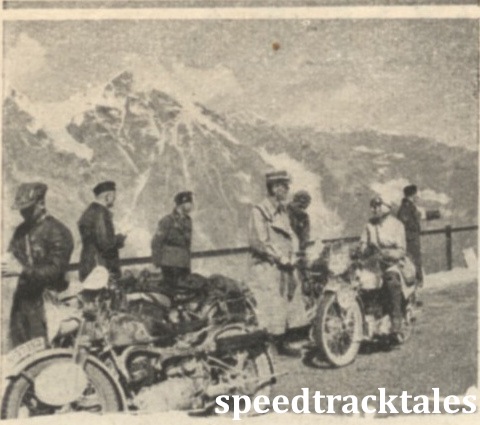
Photo - Miss Marjorie Cottle (249 Triumph), chatting with Obergruppenfuhrer Kraus, president of the International Jury, at the check at the top of the Grossglockner. Miss Cottle made a magnificent performance in the trial ISDT 1939 (Speedtracktales Collection)

Photo – Miss Marjorie Cottle (249 Triumph), chatting with Obergruppenfuhrer Kraus, president of the International Jury, at the check at the top of the Grossglockner. Miss Cottle made a magnificent performance in the trial ISDT 1939 (Speedtracktales Collection)

It is probably difficult for anyone not among the party to realise how cut off the British contingent was from knowledge of what was going on between the capitals of Europe. All at Salzburg sensed that there was a crisis, but how grave it was none knew. As we said in our description of the trial, the German papers revealed little, those British papers available were two days old, and wireless reception of the English news bulletins was next to hopeless.

Of course, there were many who started in the trial with little idea of what a modern International means. Somehow or other the impression that these trials are merely high-speed tours in glorious country still seems to exist. The facts are, as we have tried to convey in describing the event, that the modern trial as held in Germany is an Alpine Grand Prix with sections just about as bad as any included in British sporting trials.

Continue reading

ISDT 1948: Event reports – ‘the Motor Cycle’

Tags

, , , ,


Recently arrived at the Speedtracktales Checkpoint central was the two issues of ‘the Motor Cycle’ of 16th and 23rd September 1948 with a full report on the opening of the ISDT 1948, which was held at San Remo, Italy.

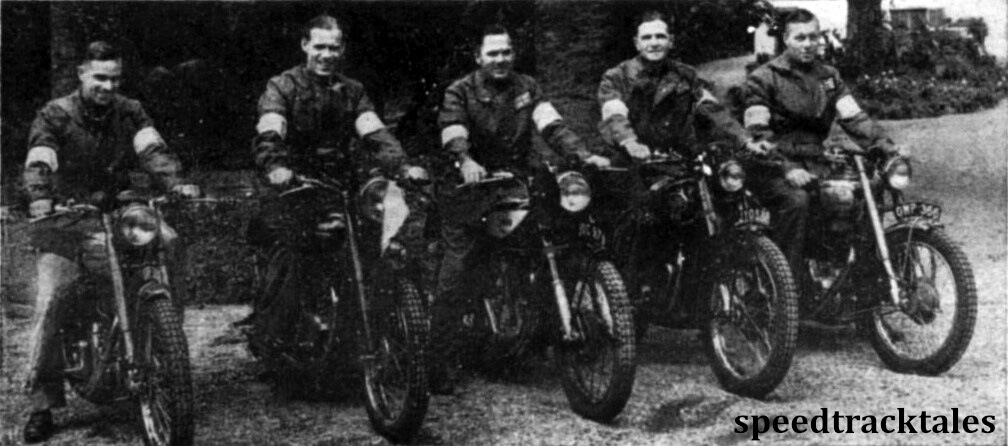
The British Trophy Team. Left to right: C.N. Rogers (346 Royal Enfield); Allan Jefferies (498 Triumph), captain; J Williams (499 Norton); B.H.M. Viney (498 AJS); Vic Brittain (346 Royal Enfield) ISDT 1948

The British Trophy Team. Left to right: C.N. Rogers (346 Royal Enfield); Allan Jefferies (498 Triumph), captain; J Williams (499 Norton); B.H.M. Viney (498 AJS); Vic Brittain (346 Royal Enfield) ISDT 1948

You can read both of the articles by following this link to our issuu.com library.

16th September 1948 – ‘the Motor Cycle

23rd September 1948 – ‘the Motor Cycle

The following summary of the event appeared in the editorial of ‘the Motor Cycle‘ 23rd September 1948

Continue reading

Mapping the ISDT: San Remo Italy 1948

Tags

, , , , , , ,


The ISDT restarted after the war and 1948 was the second year of the resurrection of the event with the British Trophy team victorious with Captain Allan Jeffries (600 Triumph), CN Rogers (350 Royal Enfield), Vic Brittain (350 Royal Enfield), Hugh Viney (500 AJS), and Jack Williams (500 Norton). I now have been lucky to set my hands on copies of both issues of ‘the Motor Cycle‘ covering the event which is featured in this blog on the event. However here is the course map for the ISDT 1948 which we hope to use to digitise a modern map for the original route.

image - route map for ISDT from 'the Motor Cycle' ISDT 1948

image – route map for ISDT from ‘the Motor Cycle‘ ISDT 1948


A ripping yarn from 1919 about Motorcycle Trials in Llangollen

Tags

,


It was interesting to find this news cutting of the 6 June 1919 as it indicates the trials in the area that used the Allt y Bady had some kind of ‘Official’ status back in 1919 which is confirmed in this story of two motorcycle traffic offences which took place in the vicinity of the Allt y Bady although were not related to competitors in the event.

Motor Cycle Trials Sequel.
CONVICTION AT LLANGOLLEN.
At Llangollen Petty Sessions, on Monday, before Lord Trevor and other magistrates, William Amos Rossenall Brown, 5, Bayswater road, Handsworth, Birmingham, was charged, by P.S. H. Jones with having driven a motor cycle at a dangerous speed in the town. Defendant, who did not appear, was represented by Mr. E. Foulkes Jones.- P.S. Jones stated that on May 18th defendant came down a hill and round a corner at a very high speed. There was a lot of motor traffic about and if defendant had met any other vehicle on the corner a serious accident would have occurred. In defence, Mr. Foulkes Jones said defendant’s machine had got very over-oiled and he was travelling down hill on low gear.-— Defendant was fined £5 and costs.
H. W. Graesser Thomas, Riversdale, Ruabon, was charged by P.S. Jones with driving a motor cycle and sidecar recklessly at Grapes Hill, Llangollen, on May 18. Mr. G. M. G. Mitchell, Shrewsbury, appeared for defendant. — P.S. Jones said that from information he received he went to Grapes Hill, on May 18 and saw defendant there. He found an accident had taken place and questioned defendant about it. Defendant told him that he was descending the hill, and when he applied his brake the machine skidded and toppled over. Two children had been knocked down, and defendant gave the children’s mother £2 to cover the injury to the children and the clothing.— Cross examined, He did not know official trials were being carried out at Allt-y-bady. There were a lot of motorists about, witness arrived on the scene about 5 minutes after the accident. The children had their clothes torn, one had a bruised arm and the other a cut knee. — Mr. F. W. Roberts said he was coming down the Grapes Hill at the time together with his two children. He saw defendant’s motor cycle coming behind him, He walked towards the footpath, and as soon as he stopped on the path the cycle knocked his children down. The hill was very dangerous and defendant was on the wrong side of the road. Defendant told witness he did not know he had knocked anybody down, but gave witness’s wife £2. The children, who were aged 3 and 7 years respectively, were walking on the road and not on the footpath. Harold Dean also gave evidence and said, so far as the children were concerned it was a pure accident.— Defendant said he was a manufacturing chemist. He had beem driving for 10 years and daily for the last 3 years. He had travelled over 6,000 miles on his present machine, and had never been summoned before. When he was descending Grapes Hill he picked up Mr. Diggory. He was travelling slowly on second gear. His machine was a 8-10 h.p. machine, which, in second gear, would only travel 18 to 20 miles an hour all out. At the spot where the accident occurred he (defendant) was actually stopping in order to set Mr. Diggory down on the corner. Just when he was slowing down some flies got into his left eye, and in putting his hand to his eye ‘he must have opened the throttle of his machine, which shot forward. He pulled the machine across the road and in doing so; it toppled over. If he had been travelling fast the machine would have suffered, but no damage was done except to bend a foot rest. The lamp was not damaged and neither was the lamp glass broken. He did not see the children until after the accident, when the father told him he had knocked them down. He then gave the children’s mother £2 to cover the damage. – Mr. L. C. Diggory, who was riding on the back seat of defendant’s machine, corroborated defendant’s statement, and said the accident occurred about 30 yards from where defendant was going to put him down. — Defendant was fined £5. We understand that Mr. Graesser Thomas intends to appeal against the decision.

It is possible Mr LC Diggory was one of the Diggory’s who owned iron foundries and Flour water mills at nearby Froncysyllte, 
ISDT 1961: Wales – the arrival of the Special Test

Tags

, ,


If you were to ask many current followers of the ISDE what part they might take most interest in.. it will be the ‘Special Tests’ usually one Cross Country and one MX style each days is designed to sort out the wheat from the chaff of the sporting elite off-road motorcycle racers. Back in the early days of the ISDT the to hell or glory race was on the last day and if your national squad got through 5 days unscathed it would be the speed test, usually on a road race style circuit that the race was decided.

Back in the 1950’s it was clear the sport splitting from its roots of being an event to determine the greatness of the bike as the European Nations became more interested in the quality of the riders. However the paymaster of the event, the Motorcycle Industry, wanted to maximise the marketing value of winning the event. However as the global dominance of the British Bike industry started to wain, it was recognised for the sport to thrive required a new objective which was to measure the rider rather than the bike. The drive to this were the european nations however the greatest act to confirm this shift was from Britain’s Auto Cycle Union who supported the need to provide daily tests to identify the best riders as the event progressed.

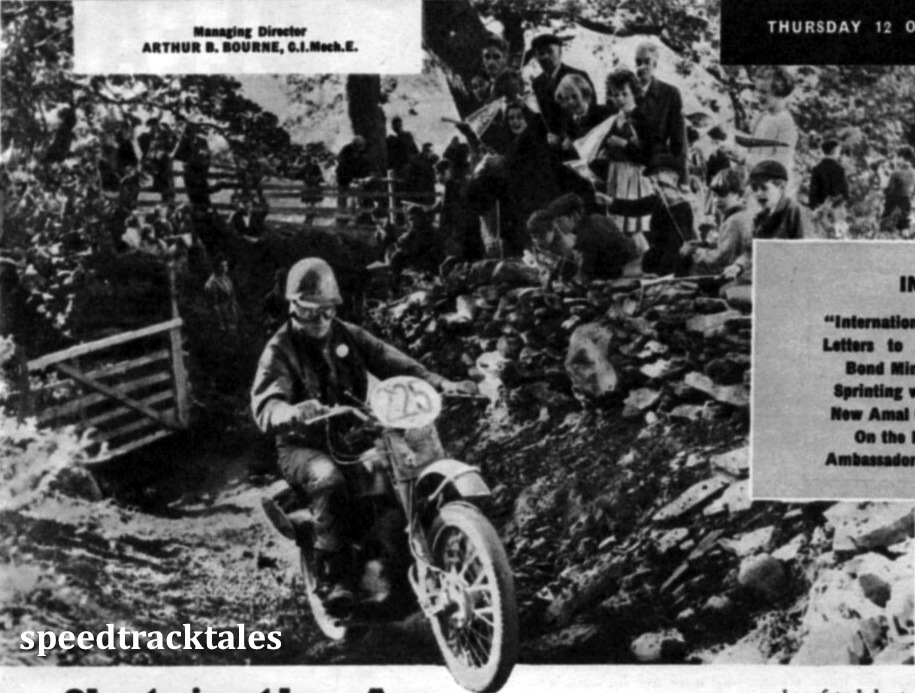
Photo - "International" spirit: Welsh children cheer #225  J.H.L Lewis (246 Greeves) as he climbs a rocky section near Llandrillo on the fourth day.

Photo – “International” spirit: Welsh children cheer #225 J.H.L Lewis (246 Greeves) as he climbs a rocky section near Llandrillo on the fourth day. ISDT 1961

In 1960 the ISDT in Austria trialled a British idea of having two special tests a day to examine which riders where performing best rather than who was able to hang in to the pace set by the organisers. The trial worked and in 1961 the F.I.M introduced two mandatory special tests a day for the ISDT 1961. The fact this was driven by the British for a British hosted event where the home nation failed to excel is one of the most obvious milestones marking the ultimate demise of the British Motorcycle Industry within 15 years as this editorial from ‘the Motor Cycle’ of the 12 October 1961 alludes to.

IT made a welcome change to be writing in the sunshine and among the mountains of Wales instead of in the office. Yes, I was having a few days on the “International” and enjoying every minute of it.

Continue reading

Reliability Trials: Reliance Trial 1924

Tags

, , , , ,


This report of the 1924 Trial was published in the magazine Motor Sport in December 1924 and shows how the event started from Liverpool and crossed across North Wales and featured many of the ISDT greats such as Miss E Foley, NPO Bradley, Marjorie Cottle, B Kershaw and FW Giles.

Photo - taken from ;Motor Sport' article from Dec 1924 shows well known Liverpool Motoring specialist Victor Horsman

Photo – taken from ‘Motor Sport‘ article from Dec 1924 shows well known Liverpool Motoring specialist Victor Horsman

The Reliance Cup Trial of the Liverpool Motor Club.

As usual the Reliance Cup Trial proved to be one of the outstanding events of the sporting season now rapidly drawing to a close. The course followed was from Liverpool to the Vale of Llangollen and back, including such important sections as the Colonial portion from Boundary Stone to Cilcain, Maes-y-Safn, Allt-y-Bady, Bryn-Eglwys and Bodfari.

Continue reading

ISDT 1948: Gold medal saved

Tags

, ,


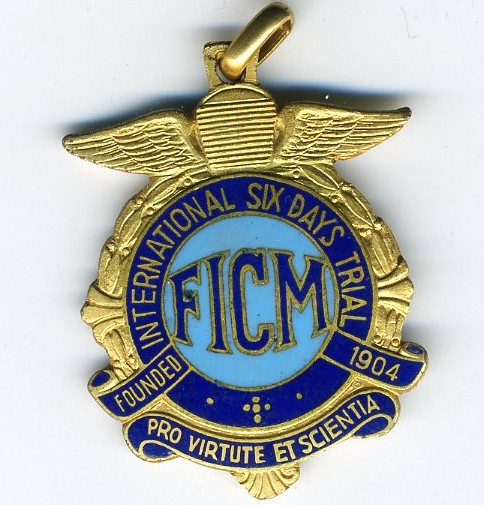
Hot news – ISDT 1948 Gold Medal rescued from Flea Bay. Unfortunately no information exists as to who the person awarded the medal was.

Photo - Gold Medal (front) ISDT 1948

Photo – Gold Medal (front) ISDT 1948

Photo - Gold Medal (rear) ISDT 1948

Photo – Gold Medal (rear) ISDT 1948


Reliability Trials: Reliance Trial 1935

Tags

, , , , , , , ,


I was recently very fortunate to stumble on an original copy of ‘the Motor Cycle‘ for 1935 in which there was a 3 page report with images of the Liverpool Motor Club’s ‘Reliance Trial’

The event which had become a classic on the British sports calendar was a reliability trial and not a sporting trial so the skill was sustaining riding for the duration of the event rather than excelling at specific section challenges. in 1935 the event was based at Mold in Flintshire although in its earliest years it had started on Merseyside with competitors travelling into North Wales.

This is the Article as published in ‘the Motor Cycle‘ October 24th 1935

IN spite of a timed restarting test on Allt-y-Bady and a short, rough section that had to be covered at not less than schedule speed, it was impossible to separate the performances of the only two riders who retained clean sheets in last Saturday’s Reliance Trial in North Wales. The two out standing men who were G.E.Rowley (560 A.J.S.) and L.G.Holdsworth (346 New Imperial), and as there was no rule giving preference to the smaller capacity machine, the two stand as joint holders of the ‘Reliance Trophy. Thus a most unusual situation is created, for It seldom happens in open events that the “premier” cannot be placed in one particular direction, especially when two special tests are used in view of possible ties.

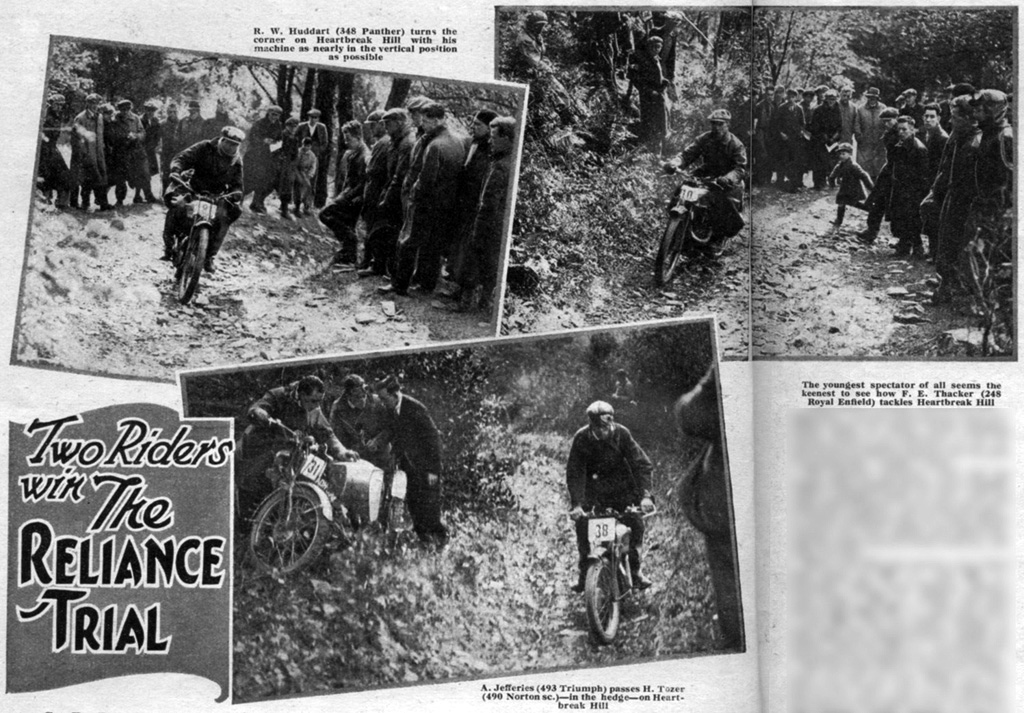
Photo - Trials riders find their way up Heartbrak Hill, Glyn Ceiriog during the Reliance Trial 1935

Photo – Trials riders find their way up Heartbreak Hill, Glyn Ceiriog during the Reliance Trial 1935

This year the trial started at Mold instead of at Llangollen, although it finished at the latter place as usual. The change was thought to indicate that something new would be introduced, but the event was much the same as other Reliance Trials, with the hills of the Bady range as the notable obstacles, Heartbreak and Ken’s Cut in particular. Vron, that long grassy slope which seems endless (and surfaceless) on a wet day, proved no stumbling block on this occasion, and Allt-y-Bady, which is slowly reverting to trials calibre after being repaired a few years ago, was used for the timed restart. In spite of the 1 in 3.8 gradient now having a surface “like a heap of dominoes’.’ (as one rider put it), even two-fifties made no bones about standing starts, which is an indication of the improvement in modern engines and the grip of present-day “comp.” tyres. The sidecars, however, were not too happy; they needed all the urge available from a gradient point of view, and yet when their skippers “gave them the gun” it mostly happened that the front wheels caressed the earth lightly and sportively and the outfits slewed round crabwise, and that was that.

Continue reading

Speedtracktales and the history of the Reliability Trial

Tags


In this post to commemorate the 2nd anniversary of Speedtracktales V2, I’m going to admit that I promised the site would not just cover its core topic of the International Six Days Trial (ISDT) but would delve into the history of the ‘Reliability Trial’ which for the english riders was the origin of events was later re-named ‘Enduro’. ‘Observed Trials’ developed from another discipline the ‘Sporting Trial’

I am in particular keen to ensure the history of Welsh based Reliability Trials such as the Liverpool MC organised ‘Reliance Trial’ survives as a public record. These events were often the means by how the going for the ISDT was discovered and brought together the skilled teams of route markers and travelling marshalls.

During May I will be featuring in the STT Blog full original magazine reports on both the 1934 ((to come) and the 1935 (here) edition of the Reliance Trial, as well as a number of articles written from the period about the development of both branches of the trials sport.

This will also include a long forgotten road test of the 1934 Model 5/5 500cc ohv and Model 6/1 Twin ohv Triumphs which was undertaken over much of the North Wales section of the ISDT 1933 route including Allt y Badi, Hirnant, Eunant Pass and the Bwlch y Groes and other classic mountain roads of the time which can be read here.

Photo Riders on the final Section of the Reliance Trial 1934 p Blonde Ethel

Photo – Riders with spectators on the final section of the Reliance Trial 1934 on ‘Blonde Ethel’

The winner of the 1934 Reliance Cup was none less than ISDT stalwart George Rowley riding a 560cc AJS, with the BSA team of Perrigo, Povey and Ashworth picking up the team award.

Continue reading

Mapping the ISDT: 1951 Italy

Tags

, , , , , , , ,


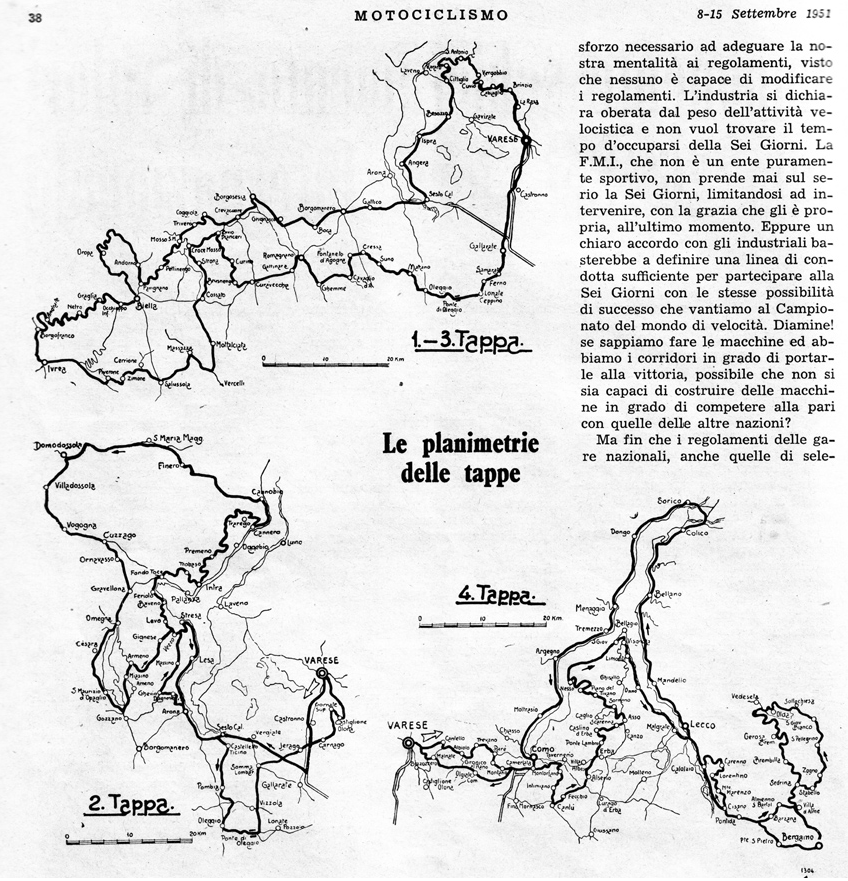
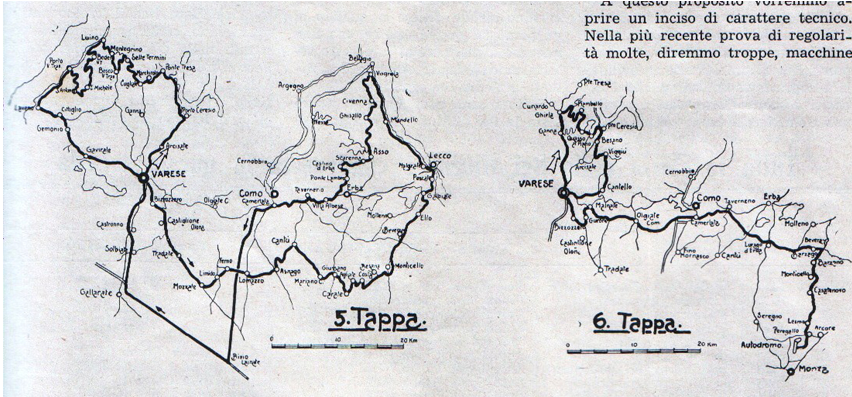
Image - scanned map of course ISDT 1951

Image – scanned map of course ISDT 1951

Image - scanned course map of ISDT 1951

Image – scanned course map of ISDT 1951

This list of places along the route was released in an article in ‘the Motor Cycle‘ 19 July 1951.

THE MOTORCYCLE, 19 JULY 1951

International Six Days’ Trial  September 18 to 23

Routes for the International Six Days’ Trial have now been issued. The event is to be held in Italy from Tuesday, September 18, to Sunday, September 23, with Varese as the headquarters. On the fourth day, the Friday, there will be a night run, just over 100 miles in length. Total mileage of the route will be approximately 1,220 plus the high-speed test, which will be at Monza autodrome.

Continue reading